A 3 point sermon outline organizes one central biblical idea into three clear supporting points. A strong outline usually includes a Scripture or text, one main idea, an engaging introduction, three connected points with explanation and application, and a conclusion that invites people to respond.
I used this framework throughout 18 years of preaching because it helped me do something every preacher has to learn: say the right thing clearly instead of trying to say everything.
The three-point structure isn’t a rule, and it isn’t the only way to preach. It’s simply a practical framework that can help you organize your thoughts, keep your message focused, and give people something clear to follow and remember.
Below, you’ll find a free 3 point sermon outline template, a completed sermon example, and a step-by-step process you can use to build your own message.
You’re not trying to say everything. You’re trying to say the right thing clearly.
The Basic 3 Point Sermon Structure
Why should people care about this message right now?
What is the one truth you want people to understand and remember?
Introduce a clear truth that supports the Big Idea.
Develop the Big Idea with a second connected truth.
Bring the message toward a final truth and response.
Bring the message together, restate the Big Idea, and invite people to respond.
Each point should support the same Big Idea. If the three points are heading in different directions, you may be preaching three separate sermons instead of one clear message.
Free 3 Point Sermon Outline Template
Start by identifying your Big Idea, the one truth you want people to understand and remember. Then develop three connected points that support that idea. Once the body of the sermon is clear, go back and write your hook and conclusion so the entire message moves in the same direction.
Scripture / Text
What passage, text, or biblical truth is guiding this message?
The Hook
Why should people care about this message right now?
Choose an opening that naturally connects your listeners to the Big Idea.
Big Idea
What is the one truth I want to make unmistakably clear?
Try to express the heart of your sermon in one clear sentence.
Build the first support
Develop the message
Move toward response
The Landing
How can I bring the message together and clearly restate the Big Idea?
Don’t simply stop after Point 3. Give your listeners a clear sense of where the message has been leading.
The Invitation
What might obedience, response, or a next step look like this week?
Your conclusion doesn’t have to be complicated. Help people understand what they can do with what they have heard.
Review the outline
- Do all three points support the same Big Idea?
- Does each point add something necessary rather than repeating the others?
- Is each point rooted in the Scripture or text rather than forcing Scripture to fit my outline?
- Have I included application, not just explanation?
- Do my transitions help the sermon feel like one connected message?
- Does the conclusion give people a clear opportunity to respond?
One of the most common problems with a three-point sermon is creating three good points that don’t actually belong together. When the points are moving toward different conclusions, the preacher can end up delivering three sermons inside one message.
See a 3 Point Sermon Outline in Action

A 3 Point Sermon Outline From James 1
Sermon Outline Breakdown
| Timestamp | Section | What to Notice |
|---|---|---|
| Hook | I open with a simple question: Who likes tests? It immediately introduces the subject in a way everyone can relate to before moving into James 1. | |
| Scripture / Text | James 1:2–4 becomes the biblical foundation: trials test faith, produce perseverance, and can lead toward maturity. | |
| Big Idea / Point 1 | The first major idea becomes clear: what has been tested can be trusted. The sermon begins developing the value and purpose of testing rather than treating trials as meaningless. | |
| Illustration + Application | A story about a student throwing away his test helps make the spiritual idea concrete: we can treat life's tests the same way and miss what they could produce in us. | |
| Developing Point 1 | Galatians 5, the muscle-growth illustration, and the repeated testing metaphor all reinforce the same idea. The section eventually narrows to the central question: “Will you trust me?” | |
| Point 2 | The test will prove you if you'll persevere. Here the message moves from the purpose of testing to what it requires from us. | |
| Illustration + Application | The junior-high fight story illustrates the value of being prepared for something difficult. That connects back to James warning believers that trials will come. | |
| Developing Point 2 | The focus shifts toward what we know about God, the commitments we hold onto, and how those determine what a trial produces in us. | |
| Point 3 | It's okay to copy. The phrase creates curiosity, and the point develops into copying/following Jesus, the one who has already “aced the test.” | |
| Scripture + Explanation | James's relationship to Jesus becomes the bridge into the final point. The message moves from James's skepticism to his devotion and then toward Jesus as the one worth trusting and following. | |
| Landing | John 16 pulls the message back toward the central theme: followers of Jesus will encounter trouble, but they can trust Him in it. | |
| Invitation / Response | You move from explaining the message to asking people to respond: receive Christ's peace and allow the trial to make them more complete. |

Created by Evan Doyle
Pastor, preacher, and ministry leader for 18 years
I developed this framework through years of preparing and preaching hundreds of sermons, teaching in different ministry settings, and helping other pastors and communicators make their messages clearer and easier to follow.
My approach to preaching is simple: clarity matters because people can’t respond to a message they don’t understand. The goal isn’t to sound like someone else or deliver a perfect sermon. It’s to faithfully communicate what God has given you to say in a way people can understand, remember, and respond to.
Want a Repeatable Process for Preparing Your Sermons?
A 3 point outline can give your sermon structure. But structure is only one part of preparing and delivering a message with clarity and confidence.
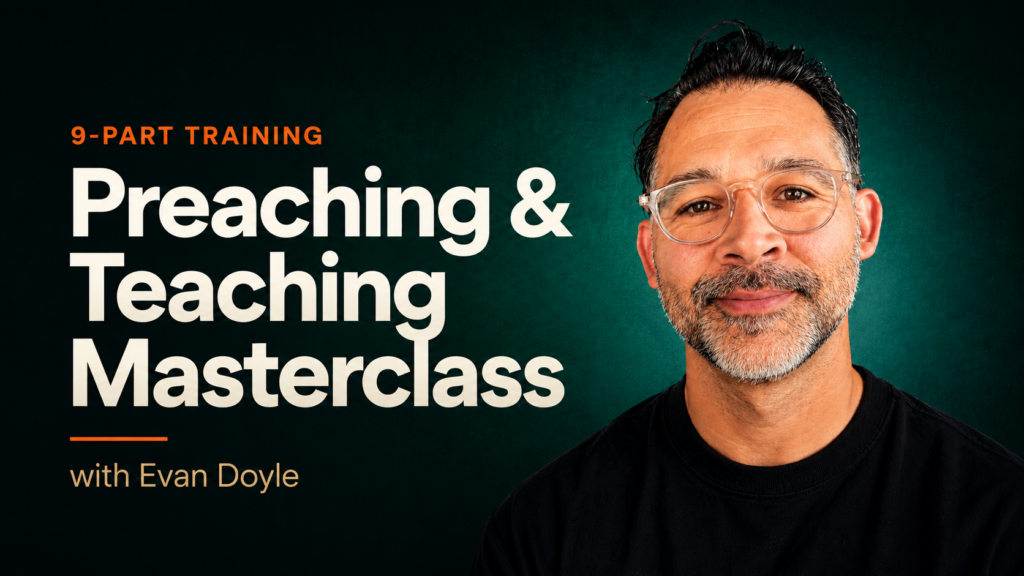
If you regularly find yourself staring at scattered notes, struggling to identify the main idea, wondering what to cut, or trying to pull everything together late in the week, I created the Preaching & Teaching Masterclass to help.
The 9-session on-demand Masterclass walks you through the larger process of preparing and communicating a message, including how to:
- Clarify the Big Idea before building your outline
- Develop a repeatable sermon-preparation rhythm
- Structure a message people can follow and remember
- Choose stories and illustrations that actually serve the message
- Connect biblical truth to the people you’re speaking to
- Find your own preaching voice instead of imitating someone else
- Prepare and deliver with greater clarity, confidence, and presence
The outline gives you the structure.
The Masterclass gives you the complete process.
9 on-demand sessions + the complete Sermon Toolkit. Watch at your own pace and reuse the frameworks for future messages.
What Is a 3 Point Sermon Outline?
A 3 point sermon outline takes one central message, or Big Idea, and develops it through three connected supporting truths. The three points are not three separate sermons. Each point should strengthen the same main idea and move your listeners toward the same conclusion and response.
A simple way to picture it is:
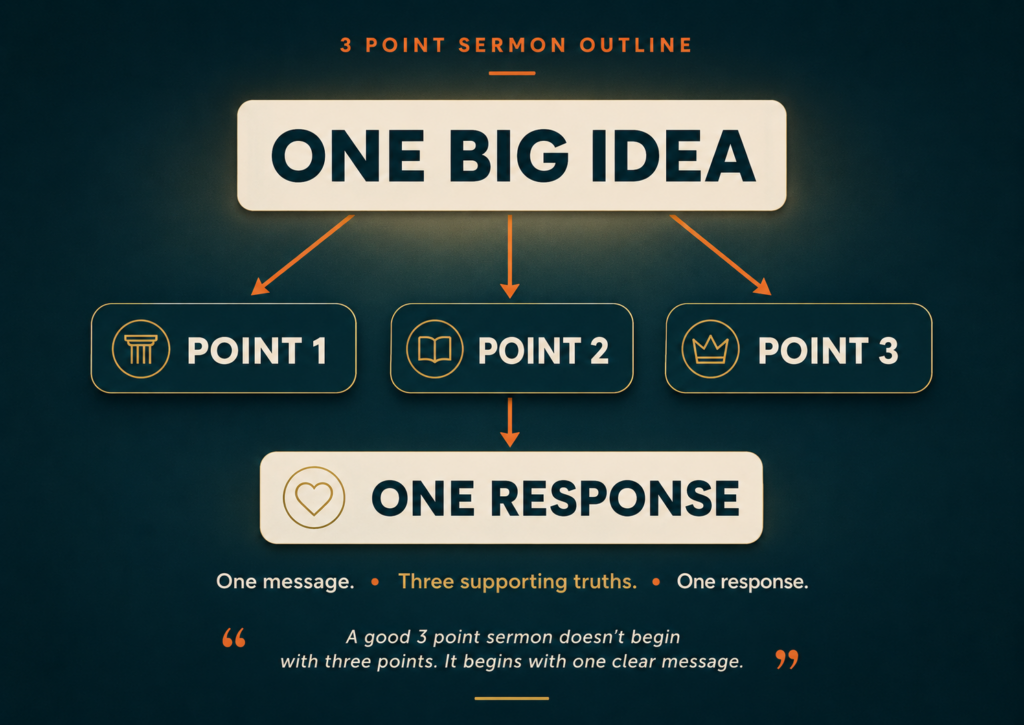
The Big Idea is the truth holding the entire sermon together. Your three points help explain, develop, and apply that truth from different angles.
For example, suppose your Big Idea is:
We can trust God even when life feels uncertain.
Your three points might be:
Point 1: God is present when we feel afraid.
Point 2: God is trustworthy when we cannot see the outcome.
Point 3: Trust allows us to move forward in obedience.
Each point says something different, but all three are helping the listener understand and respond to the same central truth.
Your Three Points Should Work Together
One of the easiest mistakes to make when writing a sermon is finding three good ideas that do not actually belong in the same message.
A point can be biblical, interesting, and worth teaching and still not belong in this sermon.
A helpful question to ask while outlining is:
Does this point make my Big Idea clearer?
If the answer is no, consider saving it for another message.
Your points should build on one another rather than compete with one another. When they move in different directions, listeners are forced to follow multiple trains of thought, and you can unintentionally end up preaching three sermons inside one sermon.
That is why I like to think of a three-point outline less like three separate topics and more like three supports holding up the same central message.
A good 3 point sermon doesn’t begin with three points. It begins with one clear message.
Why Use Three Points in a Sermon?
A three-point sermon structure is not magical, and every sermon does not need three points. Its value is not the number three. Its value is clarity.
When you limit a message to three connected points, you are forced to decide what matters most. That can help you cut unnecessary material, keep the sermon moving in one direction, and give your listeners a clear path they can follow from beginning to end.
Three points can also give people what I like to call memory handles. Most listeners will not remember everything you say on Sunday. But they are much more likely to remember a few clear ideas that all reinforce the same central truth.
I have used this framework while preaching to adults, teaching students, leading staff devotionals, and communicating in a variety of ministry settings. The exact structure may change from message to message, but the principle remains the same:
Structure creates clarity. And clarity gives people a better opportunity to understand and respond.
A good outline also helps the preacher.
It gives you a framework for deciding what belongs in the sermon and what does not. Instead of carrying dozens of notes, observations, Scriptures, illustrations, and ideas into the message, you have a structure that helps you organize them around one central purpose.
The three-point framework can help you:
- Stay focused on one Big Idea instead of trying to say everything.
- Organize your thoughts into a progression your listeners can follow.
- Give listeners memorable ideas they can carry with them after the sermon.
- Create stronger transitions between different parts of the message.
- Recognize what needs to be cut when something does not serve the central idea.
- Move toward application and response instead of simply delivering information.
That is why I think of a sermon outline as a framework, not a formula.
Your sermon may eventually need two points, four movements, a narrative structure, or something completely different. The goal is not to force every message into three boxes.
The goal is to give the message enough structure that people can clearly understand where you are taking them and why it matters.
How to Write a 3 Point Sermon Outline in 6 Steps
To write a 3 point sermon outline, start with the biblical text and the central truth you want to communicate, not with three clever points. Once you can state the Big Idea clearly, build three connected points that develop that truth, add explanation and application to each, and then write an introduction and conclusion that support the same message.
Start With the Scripture or Text
Before you start trying to come up with three points, spend time with the Scripture, topic, or biblical truth you are preparing to teach.
Read the passage carefully. Study its context. Take notes. Ask questions. Pay attention to repeated ideas, tension in the text, and what the passage actually seems to be saying.
At this stage, don't force the passage into a three-point outline.
The goal is first to understand the text as faithfully as you can. Your sermon structure should eventually help communicate what is already there, rather than finding three ideas and then searching for verses that support them.
In my own preparation process, I like to gather more material than I will eventually use. That gives me something to work with before I begin cutting, organizing, and deciding what the sermon actually needs.
Study before you structure. Let the message emerge before you start building the outline.
This is also the order used in my sermon-preparation framework: listen and study first, then move into outlining and structuring the message.
Identify the Big Idea
Once you've studied the text, ask yourself:
What is the one truth I want to make unmistakably clear?
Try to answer that question in one sentence.
This is your Big Idea.
If you can't explain what the sermon is really about in one clear sentence, you probably aren't ready to create the three points yet.
One simple way to develop the Big Idea is to answer two questions:
Why we carry so much worry.
God invites us to trade worry for trust.
We can trade our worry for trust because God invites us to cast our cares on Him.
Your Big Idea becomes the filter for the rest of your outline.
As you decide what stays and what gets cut, keep asking:
Does this help make the Big Idea clearer?
If it doesn't, it may not belong in this sermon.
The Big Idea Distiller I use in my sermon-preparation process is built around this same principle: reduce everything you've studied to one clear, preachable truth before building the rest of the message.
Develop Three Points That Support the Big Idea
Now you can begin developing your three points.
Each point should say something distinct, but all three should support the same central truth.
Think of the points as three movements within one message rather than three unrelated topics.
For example, if the Big Idea is:
We can trust God even when life feels uncertain.
God is present when we feel afraid.
God is trustworthy when we cannot see the outcome.
Trust allows us to move forward in obedience.
Notice that each point adds something different, but none of them leaves the central subject.
Whenever possible, keep your point statements short, clear, and memorable. Parallel wording can also make them easier for listeners to follow.
And don't feel obligated to use every observation you discovered during your study.
One of the hardest parts of sermon preparation is deciding what not to say.
If it doesn't serve the Big Idea, you probably don't need it.
Your sermon will usually become clearer when you remove competing ideas rather than adding more material. My Masterclass teaches this same principle: clarity often comes through cutting clutter and keeping only what serves the central message.
Build Out Each Point
Once you have the three main statements, develop each point enough to help people understand the truth and know what to do with it.
I like to work through five basic elements:
- Statement — What truth am I communicating?
- Scripture — Where is this grounded biblically?
- Explanation — What does it mean?
- Illustration — What could help people see or understand it?
- Application — What difference should this make in someone's life?
You do not have to give equal time to every element in every point. Some points may need more explanation. Another may benefit from a story. Another may move quickly toward application.
The framework is there to help you think through the message, not to make every point sound identical.
Your basic structure might look like this:
POINT 1
Truth → Scripture → Explanation → Illustration → Application
POINT 2
Truth → Scripture → Explanation → Illustration → Application
POINT 3
Truth → Scripture → Explanation → Illustration → Application
That is the basic body structure used in the Sermon Builder.
Why are we moving from this idea to the next one?
As you're developing the points, also think about how you will move from one to the next.
Don't assume your listeners will automatically make the connection.
You may understand exactly how Point 1 leads to Point 2 because you've spent hours preparing the sermon. The person hearing it for the first time hasn't.
A simple sentence connecting the ideas can make the entire message easier to follow.
Great points can still feel disconnected if the transitions between them aren't clear.
Write the Hook
Once you know the Big Idea and the direction of the three points, go back and create the opening.
I usually recommend writing the hook after you understand where the sermon is going.
That makes it much easier to create an introduction that actually serves the message rather than simply trying to say something interesting at the beginning.
Ask:
Why should someone care about this message right now?
Tension — Identify a gap between what is and what could be.
Story — Tell something relatable that opens the door to the subject.
Question — Ask something that causes listeners to engage mentally.
Problem — Name something people are already experiencing.
Humor — Use it when it is natural to you and actually serves the message.
The goal of the hook isn't simply to get attention.
It's to create a bridge into the Big Idea.
If you tell a great story but your listeners eventually wonder, What did that have to do with the sermon?, the story didn't do its job.
Your Sermon Builder treats the Hook as the place where you establish the tension and answer the listener's unspoken question: Why does this matter right now?
Land the Sermon and Invite a Response
Don't let Point 3 become the accidental ending of your sermon.
Land the message.
Return to the Big Idea and remind people where you have taken them.
You don't necessarily need to repeat all three points word for word. Instead, bring the ideas together and make the central truth unmistakably clear one more time.
Then ask:
What might obedience or response look like because of what we've heard?
That response could involve:
The specific response will depend on the sermon.
But the goal is to help listeners move from:
“I understand what you said.”
“I understand why it matters and what I can do with it.”
Earlier in my preaching, I sometimes spent most of my preparation on the body of the sermon and assumed I would figure out the ending when I got there. I learned that a message without a clear landing can leave people unsure what they are supposed to do with everything they just heard.
So give the conclusion the same intentionality you gave the rest of the outline.
The Sermon Builder follows that same progression: recap the Big Idea and then invite the listener toward a meaningful response.
Don't just finish the sermon.
Land the message.
Common 3 Point Sermon Outline Mistakes
A three-point structure can bring clarity to a sermon, but only if the points actually serve the message. Most problems come from trying to fit too much into the outline or forcing the structure instead of letting it support the biblical text.
Here are five common mistakes to watch for.
1. Starting With Three Points Instead of the Big Idea
It is easy to begin by asking, “What are my three points?”
A better question is:
What is the one truth I want people to understand and remember?
Clarify the Big Idea first. Then let the three points develop and support that central truth.
If you start with three interesting ideas and try to connect them afterward, the sermon can feel scattered before you even begin.
2. Forcing Scripture to Fit the Outline
The three-point structure should help you communicate the text, not control what the text is allowed to say.
Study the passage first. Understand its context and central message. Then build a structure that helps people follow what is already there.
The outline should serve the Scripture. The Scripture should not be forced to serve the outline.
3. Putting Too Much Into Each Point
One point does not need five subpoints, four illustrations, six cross-references, and everything you discovered during study.
Trying to include too much often makes the sermon harder to follow.
Ask yourself:
What does the listener actually need in order to understand this point and how it supports the Big Idea?
Keep what serves the message. Save the rest for another sermon.
4. Using Three Points That Don’t Connect
You can have three good, biblical points and still have a weak sermon if they are moving in different directions.
Each point should contribute something distinct while still leading toward the same conclusion.
A simple test is:
If I removed the Big Idea from the page, would these three points still clearly belong together?
If not, you may be trying to preach more than one sermon at the same time.
This is one of the most common problems I warn against in the Sermon Masterclass: when the points do not drive toward the same conclusion, you can end up preaching three sermons in one.
5. Neglecting the Transitions and the Landing
Strong points do not automatically create a strong sermon.
Listeners also need help understanding how one idea connects to the next and where the entire message is ultimately going.
Write your transitions intentionally.
Then give the sermon a real ending. Do not simply finish Point 3 and stop.
Return to the Big Idea, bring the message together, and help your listeners understand how they can respond.
A clear sermon is not just three good points. It is one connected message from beginning to end.
Does Every Sermon Need Three Points?
Every sermon does not need three points.
A three-point outline is a helpful framework because it can create focus, organization, and clarity. But it is not a biblical requirement, and it should never become a formula you force onto every passage or message.
Sometimes the text naturally produces three clear movements. Other times, the message may work better with two ideas, four movements, a story-driven structure, or another simple framework.
The important question is not:
How can I make this sermon have three points?
It is:
What structure will help me communicate this truth most clearly and faithfully?
Two Other Simple Sermon Structures
If a traditional three-point outline does not fit the message, here are two frameworks I have found helpful.
What → So What → Now What
What: What does the Scripture say, and what do I want people to understand?
So What: Why does this truth matter to their lives?
Now What: What should they do, believe, reconsider, or respond to because of it?
This structure works especially well when you want the sermon to move clearly from understanding to significance to application.
Another option is:
Hook → Book → Look → Took
Hook: Capture attention and introduce the tension or question.
Book: Take people into the biblical text.
Look: Explore what the text means and how it connects to life.
Took: Help listeners identify what they can take with them and put into practice.
Both are alternative sermon road maps included in my preaching framework when three points are not the best fit for the message.
Let the Structure Serve the Message
One of the reasons I teach the three-point outline is that it gives newer and experienced preachers alike a reliable place to start. But as you grow as a communicator, you should become increasingly comfortable choosing the structure that best serves the Scripture, the message, and the people listening.
Sometimes that will be three points.
Sometimes it won’t.
Structure is a tool for clarity, not a rule you have to obey.
The goal is never to successfully fit a sermon into a format. The goal is to communicate biblical truth in a way people can understand, remember, and respond to.
Ready to Build a Sermon-Prep Process You Can Repeat?
You now have a framework for building a clear 3 point sermon outline.
But if sermon preparation still feels like a weekly scramble, the problem may not be your outline. You may need a repeatable process for getting from an open Bible and a page full of notes to a message you are actually ready to preach.
That is why I created the Preaching & Teaching Masterclass.
Go Beyond the Outline
The 9-session on-demand Masterclass walks you through the entire process of preparing and delivering a message with greater clarity, conviction, and confidence.
You will learn how to:
- Find and clarify the Big Idea of your message
- Build a sustainable 6-day sermon-preparation rhythm
- Structure sermons people can follow and remember
- Know what to keep and what to cut
- Choose illustrations and stories that strengthen the message
- Understand and connect with the people you are speaking to
- Find your own preaching voice instead of trying to sound like someone else
- Prepare your delivery without turning preaching into a performance
- Reflect on each message so you continue growing as a communicator
And you will receive the complete Sermon Toolkit, with reusable frameworks and worksheets you can return to as you prepare future messages.
The outline gives you the structure.
The Masterclass gives you a process you can use again and again.
Preaching & Teaching Masterclass
9 on-demand sessions + complete Sermon Toolkit
GET INSTANT ACCESS TO THE MASTERCLASS →You do not need a more impressive vocabulary, a bigger personality, or someone else's preaching style.
You need to know what God has given you to say, why it matters, and how to communicate it clearly.
START THE PREACHING & TEACHING MASTERCLASS →